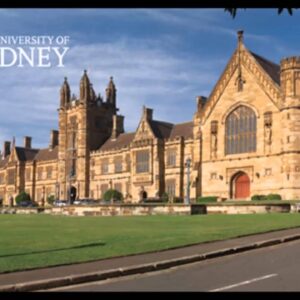
Introduction — why the University of Sydney is a top choice for research scholarships
If you’re thinking about a research degree in 2025 — a PhD or a Master by Research — and cost is a key factor, Australia’s Research Training Program (RTP) scholarships are among the most attractive options. At the University of Sydney, RTP (and equivalent university-funded scholarships) routinely cover:
-
a tax-free living stipend (the 2025 benchmark at Sydney is AUD $41,753 per year, paid regularly),
-
a tuition fee waiver for international students (RTP Fee Offset), and
-
additional relocation and thesis allowances in many cases.
That stipend isn’t an incidental perk — it’s the difference between a student working two part-time jobs and a student doing full-time research with the mental space to publish and travel to conferences. The University has a large research base, strong global networks, and a track record of placing graduates into academic, industry and development roles.
But what really matters to prospective applicants from Africa and Asia is this: many accepted candidates can qualify without a formal IELTS test under clearly defined alternatives. This opens the door for capable students who lack access to test centers or the funds/time to re-take high-stakes English tests.
In this guide you’ll learn exactly how RTP and related University of Sydney research scholarships work, how to apply step by step, what documents you need, how to make a persuasive case when you don’t have IELTS, and how to convert a scholarship into a career advantage.
Overview — what the RTP (and equivalent) scholarships at the University of Sydney actually provide
The Research Training Program (RTP) is Australia’s federal scheme to support higher degrees by research (HDR). The University of Sydney administers RTP funds to award competitive scholarships to both domestic and international students.
Key elements you need to know (officially described on the University of Sydney site):
-
RTP Stipend (living allowance): AUD $41,753 p.a. (2025 rate) — paid tax-free and intended to cover living costs while you study. (Universities may also offer matched or top-up stipends for some awards.)
-
RTP Fee Offset: Typically a 100% tuition fee waiver for international HDR students for the standard duration of the degree (e.g., 3.5–4 years for a PhD, or specified research periods for master’s research).
-
Relocation & thesis allowances: Many RTP awards include a one-off relocation grant and a thesis completion allowance to help with final costs.
-
Competitive selection: RTP awards are competitive and based on research potential, prior academic performance, and fit with a supervisor or project.
You can read the University of Sydney’s RTP overview and details on stipend and fee coverage on their official RTP page. It’s the authoritative place to check the latest stipend figures, allowances and application procedure. (University RTP page link is embedded here in the body for your reference.)
Why this matters for students from Africa and Asia
Three reasons the University of Sydney RTP scholarships are particularly relevant to applicants in Africa and Asia:
-
Financial accessibility: The combination of a tax-free stipend and full tuition offset removes the main financial barrier for many international candidates. That means fewer students must choose low-quality local options simply because of cost.
-
High-quality research infrastructure: Sydney is a Tier 1 research university with strong labs in health, engineering, AI, environmental science, social policy and more. For researchers studying problems relevant to their home countries — public health, water security, climate adaptation — working at Sydney gives access to tools, datasets and networks that can be applied back home.
-
Practical IELTS alternatives: The University of Sydney accepts a range of English-language evidence; you don’t automatically need IELTS if you can document equivalent proficiency (for instance, previous degrees taught in English, institutional letters, or other accepted test scores). That makes access more practical for applicants living far from test centers.
If your goal is to return home with skills, publications and a network that supports technical or policy leadership, a funded research degree at Sydney can be a transformational investment.
How the “No IELTS” path works at the University of Sydney (practical realities)
The University of Sydney sets a standard English-language requirement (commonly IELTS 6.5 overall with no band below 6.0 for many programs), but it also recognizes that applicants can demonstrate English proficiency in alternative ways. The university’s English requirements page lists accepted options and equivalencies — for example:
-
Completion of a prior degree taught in English at a recognized institution (this can sometimes satisfy language requirements in lieu of IELTS).
-
Other internationally recognized tests (TOEFL, PTE Academic, Cambridge qualifications) with equivalent scores.
-
Institutional letters: some faculties accept a formal letter from your previous university confirming that your instruction and assessment were conducted in English.
-
Conditional offers with English bridging: some students receive admission conditional on completing an approved English course before commencing the degree.
In short: you don’t always need IELTS to qualify — but you must provide documented evidence of English proficiency according to the university’s rules. If you think you have an alternative (prior degree in English, for example), contact the prospective faculty’s HDR admissions office early and seek pre-approval. The University of Sydney’s English requirements page lays out these options in detail and is the right place to confirm which pathway applies to your program.
Step-by-step: How to apply for a University of Sydney RTP or equivalent research scholarship in 2025
Below is a practical timeline and checklist — written for someone starting now. It assumes you aim to commence study in a standard intake (check your field for specific dates).
Step 1 — Decide research direction & shortlist supervisors (Months 1–2)
-
Identify two to four supervisors at the University of Sydney whose research aligns with your interests. Read their recent papers, mention specific projects and explain why your background fits.
-
Email potential supervisors with a concise message: one paragraph of your background, a 2–3 line description of your research idea, and attached CV/transcripts. Try to secure a positive reply or indication of supervisory interest — this matters in selection.
Step 2 — Check scholarship eligibility & deadlines (Month 2)
-
Confirm RTP eligibility with your faculty; the RTP is competitive and has specific research period deadlines (the University publishes research periods and cut-offs).
-
Look at faculty-level scholarships too: some faculties have top-up awards or targeted funding for development priorities.
Step 3 — Prepare documents (Months 2–4)
Gather and prepare:
-
Academic transcripts & degree certificates (notarized / certified copies if required).
-
Curriculum Vitae (academic CV with publications and research experience).
-
Research proposal (1–2 pages for master’s, 3–5 pages for PhD; clear objectives, methods, timeline and expected outcomes).
-
Two academic references (professors who can evaluate your research potential).
-
Evidence of English proficiency — if you lack IELTS, compile alternative documents (degree transcripts showing English-medium instruction, supervisor letter from prior institution, or other test scores).
Step 4 — Apply for admission (Month 4)
-
Submit an application for admission to the relevant HDR program through the University’s online portal. Many RTP scholarships require you be admitted or have a conditional offer to be considered for funding.
Step 5 — Apply for RTP and scholarships (Month 4–6)
-
Some RTP scholarships are centrally managed; others are faculty-nominated. Prepare to submit (or be nominated for) your scholarship application with the required forms and supporting evidence. Include a strong, concise case for your research and its potential impact.
Step 6 — Interview (Month 6–7)
-
You may be invited to a virtual interview with the faculty or selection panel. Practice explaining your research plan in plain language and describing the potential impact (especially relevant to Africa/Asia contexts, if applicable).
Step 7 — Offer, nomination and documentation (Month 7–9)
-
If selected, the university nominates you for the RTP. For international candidates, RTP Fee Offset is confirmed and you receive an official offer letter. Complete any outstanding proof-of-English or health checks and apply for an appropriate student visa.
Step 8 — Pre-departure & arrival (Month 9+)
-
Arrange travel, housing, health insurance (the University handles some parts for international students), and attend orientation. Early contact with your supervisor smooths set-up.
Practical timing note: The RTP selection rounds and research periods vary by faculty; start early, and aim to contact supervisors 6–8 months before your desired start date to allow for correspondence, application processing and visa timelines.
Table — Quick comparison: RTP (University of Sydney) vs Other typical research funding
| Feature | University of Sydney RTP & Equivalents | Typical University Scholarships (non-HDR) | External Fellowships (e.g., government, bilateral) |
|---|---|---|---|
| Stipend (2025) | AUD $41,753 p.a. (tax-free) + relocation/thesis allowances. | Varies widely; often smaller (AUD $25k–35k) or stipend + tuition rebate | Variable; often competitive with higher stipends but restricted fields |
| Tuition coverage | RTP Fee Offset — full tuition waiver for international HDR students | May or may not include full tuition | Often includes tuition & travel; conditions apply |
| Eligibility | Competitive; research potential + supervisor fit | Merit or need-based; may target coursework or HDR | Specific to fellowships; might require home-country service |
| English test | IELTS commonly required, but alternatives accepted (see university policy). | Often similar | Depends on funder |
| Best for | Full-time PhD/MPhil research where stipend + tuition cover living & research costs | Coursework students or small project grants | Highly specialized projects or bilateral programs |
This table is a quick snapshot — always verify the precise stipend and coverage on the University’s RTP and scholarship pages, because allowances and rates are updated annually.
Key insights — what selection committees at Sydney look for
To convert an application into a funded scholarship, you need more than good grades. Selection panels consistently value:
-
Clear demonstration of research potential. Evidence: publications, conference presentations, or well-documented research projects.
-
Alignment with supervisor expertise and faculty priorities. Panels want to see that your idea is feasible and that a supervisor is ready to mentor and host your project.
-
Impact and feasibility. Can your research be executed with the available resources and within the HDR time frame? Is there clear impact — for example, policy relevance in your home country, applied solutions, or new knowledge?
-
Strong references. Academic referees who can attest to your skills, independence and potential for high-quality research carry weight.
-
English communication. Even if you avoid IELTS by other evidence, the panel must be convinced you can engage with coursework, write a thesis and publish in English. That can be shown by transcripts, prior degrees taught in English, or prior publications.
If you target these five dimensions in your application package (proposal, CV, referees, supervisor support, and English evidence), you’ll be significantly more competitive.
Benefits — what a fully funded RTP scholarship will give you in concrete terms
-
Financial security to focus on research. A tax-free AUD $41,753 stipend is enough in many Australian cities to cover rent, food, transport and research-related travel (with careful budgeting).
-
Research training and mentorship. Direct supervision by leading academics and access to labs, datasets and collaborations.
-
Networking & career pathways. Published papers, conference presentations and industry partnerships open doors to postdoctoral positions, academic jobs and industry R&D roles.
-
Practical return to home country. For many African and Asian researchers, the most valuable outcome is the ability to bring methodologies, measurements and trained personnel back home to scale solutions.
Real-world examples — how students from Africa and Asia use RTP scholarships
The examples below are composite, drawn from common applicant journeys, to illustrate practical pathways.
Example 1 — PhD in Public Health (Nigeria → University of Sydney)
Scenario: A public health professional with a master’s focused on epidemiology wants to model malaria intervention efficacy. She secured supervisor interest at Sydney in a lab that does spatial epidemiology. With RTP funding she:
-
Pays no tuition and receives a stipend to cover living expenses,
-
Uses university computational resources for advanced modeling, and
-
Partners with a local NGO to pilot a data-driven intervention that can scale back home.
Outcome: After publication and a funded pilot, she returns to work with the national malaria control program with stronger technical capacity.
Example 2 — Master by Research in Renewable Energy (India → University of Sydney)
Scenario: An engineer with industry experience wants to pilot off-grid solar microgrids with storage optimization. An Australian researcher agrees to co-supervise; the project is relevant to both Australian remote communities and Indian rural electrification.
Outcome: RTP stipend funds fieldwork and sensor deployment; the student publishes a system design and develops an auditable methodology that transitions into a startup spin-out.
Example 3 — Short research visit / fellowship (Kenya → Sydney)
Scenario: A lecturer takes a short visiting scholar role funded by a faculty-level scholarship to test new remote learning interventions for health workers.
Outcome: Knowledge transfer occurs both ways, and the faculty-level project becomes the seed for a larger application that later wins more substantial research funding.
Your Statement of Purpose — a simple, strong structure that works for HDR applications
A good SOP is focused, evidence-based and sharply aligned with a supervisor’s work. Use this simple structure:
-
Opening (1 paragraph): Who you are, your current role/degree, and a one-line statement of research intent.
-
Background (1–2 paragraphs): Key academic achievements, work experience and any research projects or publications. Give concrete evidence (e.g., “led a 6-month randomized field trial in district X; methods used: …”).
-
Why this supervisor & university (1 paragraph): Reference specific papers, labs, or datasets and explain the fit. Mention a named supervisor (if you have one) and a specific lab or resource.
-
Proposed research (2–3 short paragraphs): Objectives, methods, feasibility, timeline and expected outputs. Make the methods credible and appropriate to a 3–4 year PhD or a 1–2 year MPhil.
-
Impact & career path (1 paragraph): How this research will be used after completion — policy advice, implementation, academia, or a social enterprise.
-
Closing (1 short paragraph): Reiterate commitment, readiness for full-time research and openness to pre-admission conditions (English bridging classes etc.).
Keep the SOP focused (800–1,200 words for PhD often works best) and tie each claim to evidence or a measurable objective.
Common mistakes — and how to avoid them
Mistake 1 — Weak supervisor outreach. Fix: Personalize emails. Mention a specific paper and a realistic research gap you can address. Attach a concise one-page synopsis.
Mistake 2 — Vague methodology. Fix: Add a short methods section describing tools, data sources and a realistic timeline. Funders want to know you can finish.
Mistake 3 — Ignoring English documentation. Fix: If you don’t have IELTS, compile transcripts showing instruction in English, institutional letters, or alternative test results. Contact admissions early for pre-approval.
Mistake 4 — Late notarization and translations. Fix: Start document certification months ahead. Some embassies and universities have long backlogs.
Mistake 5 — Overlooking research ethics or permits. Fix: For human-subjects work, include a note about planned ethics approvals and timeline.
FAQs (concise, practical answers)
Q: How much is the RTP stipend for 2025 at the University of Sydney?
A: The 2025 RTP stipend benchmark at the University of Sydney is AUD $41,753 per year (paid tax-free), plus typical relocation and thesis allowances. Confirm the exact figure on the University’s RTP page.
Q: Does the scholarship cover full tuition for international students?
A: Yes — RTP Fee Offset typically covers 100% of tuition fees for the award duration (standard research periods). Always check your offer letter for specific details.
Q: Can I apply without IELTS?
A: Possibly. The University’s English policy lists alternative proofs of proficiency (prior English-medium degrees, other tests, institutional letters, or conditional offers tied to English bridging). Check the official English requirements page and confirm with admissions for your program.
Q: How competitive are RTP scholarships?
A: RTP scholarships are competitive. Selection is based on research potential, supervisor fit, academic record and quality of the research proposal.
Q: Can I work while holding RTP?
A: International students can work part-time under visa conditions, but the stipend is intended to support full-time study. Balance work and research carefully so it doesn’t slow your degree.
Budgeting & daily realities — what the stipend will actually cover
AUD $41,753/year translates to about AUD $3,480/month before any tax (but RTP stipends are tax-free). In practice:
-
Rent: Expect AUD $800–1,200/month for a shared apartment in many Sydney suburbs; inner-city rents are higher. Many students live in university halls or shared houses to reduce costs.
-
Food & utilities: AUD $300–600/month depending on lifestyle.
-
Transport: AUD $50–200/month (concessions for students apply).
-
Research costs & conferences: You’ll typically seek additional travel grants from faculties or small project funds to attend conferences (many departments offer scholarship top-ups for travel).
If you choose a lower-cost city or live in shared housing, the stipend is workable. Financial prudence — budgeting, using student discounts, and applying for research travel funds — will stretch the stipend further.
After graduation — translating the degree into impact and jobs
A fully funded HDR at Sydney opens several pathways:
-
Academic careers: Postdoctoral fellowships and teaching roles; Sydney’s research reputation and publications give you credibility on the global job market.
-
Industry R&D: Australian research often links to industrial partners — biotech, energy, data science — enabling transitions into private sector innovation roles.
-
Development & policy: For students from Africa and Asia, returning with technical expertise can mean leadership roles in ministries, NGOs, and national research institutes.
-
Entrepreneurship: Some students use research outputs to launch startups (for example, energy management tools, medtech prototypes or AI models), often supported by university incubators.
Plan early: develop a clear career plan during your degree — publish strategically, network with industry, and use the university’s career services.
Conclusion — recap and clear next steps
Recap: At the University of Sydney, RTP and equivalent research scholarships give you full tuition coverage, a competitive living stipend (AUD $41,753 p.a. in 2025), and access to world-class supervisors and research infrastructure. You can often satisfy English-language requirements without IELTS by providing alternative, documented proof of proficiency — but you must confirm this with admissions early. The RTP is competitive, so prepare a tight application: a targeted research proposal, strong referees, and supervisor support.
Call to action — three concrete next steps:
-
Visit the University of Sydney RTP page and note the stipend & deadlines (this is the authoritative source for rates and allowances). The University of Sydney
-
Prepare your research synopsis and contact 2–3 potential supervisors with a personalized email and a one-page summary.
-
Gather English evidence early if you lack IELTS: transcripts showing instruction in English, institutional confirmation letters and alternative test scores — then confirm with the faculty admissions office. The University of Sydney
“Scholarships are the hinge between aspiration and action — prepare the hand that opens the door, and the door will open.”